Category Archives: JavaScripts

Target Report their Customers’ Credit Cards Information may have been Compromise

Target says information from approximately 40 million of its customer credit and debit cards swiped in stores may have been compromised by a data breach during the height of the holiday shopping season.

target

The data breach occurred between Nov. 20 and Nov. 30, 2016, at U.S. stores, Target said in a statement this morning. Target said it immediately contacted authorities and financial institutions once it became aware of the breach. The Minneapolis based-company said it was teaming with a third-party forensics firm to investigate the breach.

“Target’s first priority is preserving the trust of our guests, and we have moved swiftly to address this issue, so guests can shop with confidence. We regret any inconvenience this may cause,” said Brian Cornell, chairman and chief executive officer. “We take this matter very seriously and are working with law enforcement to bring those responsible to justice.”

The U.S. Secret Service is investigating but declined to provide further details.

Example of JavaScript functions

JavaScript Function Syntax
A JavaScript function is defined with the function keyword, followed by a name, followed by parentheses ().

Function names can contain letters, digits, underscores, and dollar signs (same rules as variables).

The parentheses may include parameter names separated by commas:
(parameter1, parameter2, …)

The code to be executed, by the function, is placed inside curly brackets: {}
Function Invocation
The code inside the function will execute when “something” invokes (calls) the function:

When an event occurs (when a user clicks a button)
When it is invoked (called) from JavaScript code
Automatically (self invoked)
You will learn a lot more about function invocation later in this tutorial.

Function Return

When JavaScript reaches a return statement, the function will stop executing.

If the function was invoked from a statement, JavaScript will “return” to execute the code after the invoking statement.

Functions often compute a return value. The return value is “returned” back to the “caller”:

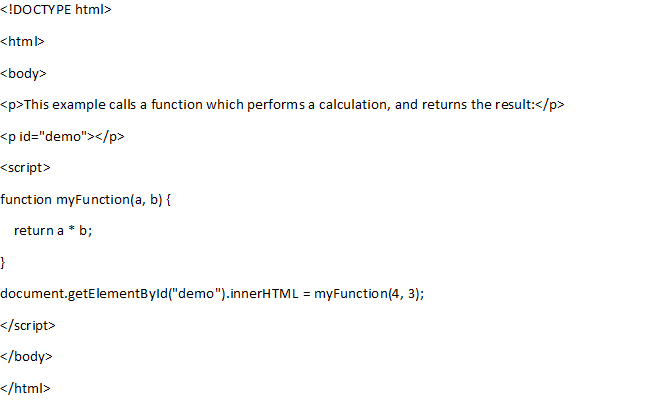
Here is a simple scripts to perform a calculation and return the desirable result


This example calls a function which performs a calculation, and returns the result:

JS function example 1

Returned result:

This example calls a function which performs a calculation, and returns the result:

12

Example 2:JavaScript Numbers

JavaScript numbers can be written with, or without decimals and
extra large or extra small numbers can be written with scientific (exponent) notation:

IS numbers


See results

34
34
12300000
0.00123

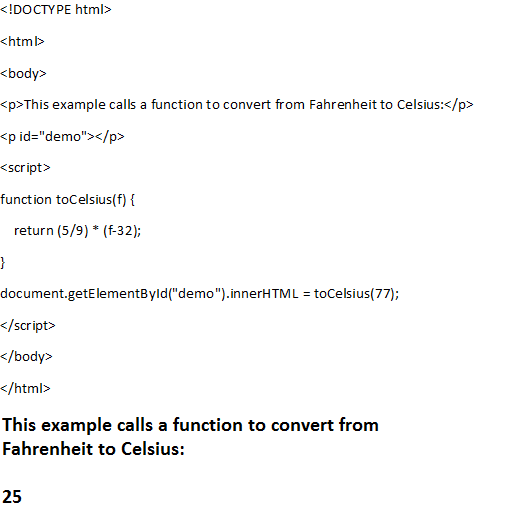
Example 3: Convert Fahrenheit to Celsius

convertfahrenheittocelsius